Lion Dance as a Visual Symbol of Cultural and Public Diplomacy: A Theoretical and Case-Based Analysis of Soft Power, Digital Amplification, and Diasporic Agency
This article examines how Chinese lion dance functions as a visual symbol in cultural and public diplomacy and argues that its soft power potential depends on the conditions of its circulation. Drawing on theories of soft power and cultural diplomacy and on research on China’s external propaganda, the discussion compares three overlapping settings: state-sponsored performances, diaspora-led festivals and competitions, and platform-based cultural content. It considers how institutional sponsorship, community ownership, and digital distribution may shape perceptions of authenticity and the attribution of cultural appeal to China. The analysis distinguishes the visibility of a performance from evidence of improved national reputation or sustained diplomatic influence. It also treats audience size, platform engagement, and reported cultural interest as different indicators whose implications cannot be assumed to be equivalent. The cases suggest that diaspora organizations and independent performers warrant greater attention alongside official cultural programming. However, differences in reach do not by themselves demonstrate that audiences prefer one sponsor type or that state involvement necessarily reduces attraction. The article therefore presents community agency and perceived authenticity as important interpretive considerations rather than universally established causal effects. It concludes that lion dance may support cross-cultural engagement when performances are locally meaningful and accompanied by opportunities for exchange. Assessing its diplomatic contribution requires transparent evidence, attention to audience interpretation, and recognition that cultural appreciation may remain distinct from attitudes toward the state.
This is an Open Access article, distributed under the terms of the Creative Commons Attribution 4.0 International License (http://creativecommons.org/licenses/by/4.0/), which permits unrestricted use, distribution and reproduction in any medium or format, provided the original work is properly cited.
Lion Dance, Cultural Diplomacy, Public Diplomacy, Soft Power, China, Digital, Diaspora
1. Introduction
Scholars offer diverse theories about the origins of lion dance
[1]
Lyu, S., Chan, R. S. K., & Olmedo, E. (2023). Sports and heritage: A review of the Chinese lion dance. Journal of Ethnic and Diversity Studies, 1(2), Article 4.
; it is commonly traced back to the Han Dynasty (206 BCE-220 CE), and its long performance tradition integrates aspects of martial arts, percussion music and intricate costume design to create a multi-sensory performance based experience. The tradition of lion dance is performed at festivals, ceremonies and major events all over the world, easily transcending linguistic and cultural barriers with little or no loss in the meaning of the performance.
The lion head represents wisdom, courage and protection, while the red and gold colours represent fortune and celebration and its acrobatic vocabulary conveys courage and a sense of collective joy, characteristics that can be recognised by all cultures without needing a verbal translation. Recent research on Guangdong lion dance examines its relationship with cultural identity and heritage preservation
[2]
Xu, D., Phanlukthao, P., & Ke, Y. (2024). Cultural identity of Guangdong lion dance in Chinese intangible cultural heritage through anthropological perspectives. International Journal of Sociologies and Anthropologies Science Reviews, 4(4), 391-400.
Nye, J. S. (2004). Soft power: The means to success in world politics. Public Affairs.
[3]
describes soft power as the capacity to achieve the desired outcome through attraction rather than using threats or incentives. The resources of soft power consist of culture, political values and foreign policy. For example, the lion dance is a cultural expression with 2000 years of artistic practices; it reflects the open political values of performing arts in state functions; it manifests the foreign policy of performing arts through embassies and Olympic-level programming. Lion dance serves as a non-verbal cultural magnet, engendering positive emotional responses in an international audience without needing a translation.
2.2. Cultural Diplomacy Model
Cultural diplomacy, according to Cummings
[4]
Cummings, M. C. (2003). Cultural diplomacy and the United States government: A survey. Center for Arts and Culture.
[4]
, is the exchange of beliefs, information and values across cultures through these elements of culture in order to create understanding between two cultures. When a person observes a lion dance, they will have a deeper understanding of the ritual based on how the performer dances. In addition to being a physical performance, the lion dance also has both rhythm and colour to express emotion, all of which can also communicate across all languages. The lion dance is a performance that creates emotional connections through the use of spectacle: the use of drumming and acrobatics to create a cohesive piece of work that is used to express culture. Since its existence has spanned the ages, the lion dance has connected both the past and present, as well as the local and global dimensions of the culture of the lion dance. In comparison to traditional text-based cultural diplomacy, an embodied performance gives audiences an opportunity to experience the culture through their senses, thereby creating an immediate and lasting cultural impression.
2.3. External Propaganda and Cultural Projection
Research on China’s external communication describes a changing and contested field. Wang
[5]
Wang, Y. (2008). Public diplomacy and the rise of Chinese soft power. The ANNALS of the American Academy of Political and Social Science, 616(1), 257-273.
links Chinese public diplomacy to the rise of Chinese soft power, while C. Y. Wang
[6]
Wang, C. Y. (2023). Changing strategies and mixed agendas: Contradiction and fragmentation within China’s external propaganda. Journal of Contemporary China, 32(142), 586-601.
argues that since 2012 external propaganda (waixuan) has moved away from its earlier emphasis on traditional culture towards promoting China’s development model, becoming more ideology-oriented and harder to make attractive to foreign audiences. Zhu
[7]
Zhu, Y. (2022). China’s “new cultural diplomacy” in international broadcasting: Branding the nation through CGTN Documentary. International Journal of Cultural Policy, 28(6), 671-683.
finds, in a study of CGTN Documentary, that the policy priority given to cultural projection meets tensions between political control and commercial imperatives, as well as uncertainty about audience reception. For lion dance, these findings point to a tension: a widely recognised traditional performance may attract audiences, yet its use in official programming may be read as part of a wider state communication effort. Whether that association helps or hinders attraction is an empirical question rather than an assumption.
3. Three Functional Roles of Lion Dance
The lion dance serves three different functions simultaneously. As a symbol of cultural diplomacy, it is used by the People’s Republic of China (PRC) government through ceremonies, events at embassies and other means to promote an image of their nation as approachable to other countries. Yang discusses the inheritance and promotion of dragon and lion dance in the context of the Belt and Road Initiative
[8]
Yang, Y. (2024). Inheritance and promotion of traditional folk sports in the context of “One Belt and One Road”—Taking dragon and lion dance as an example. Advances in Physical Sciences, 12(2), 373-378.
The lion dance is employed by provincial and municipal entities at international trade fairs and tourism marketing efforts to create a clear Chinese identity through a highly visible and recognized marker. Additionally, the lion dance is also created through digital diplomacy channels (through YouTube videos, TikTok videos, Instagram posts) to create an organic circulation of cultural content that is not directly affiliated or distributed through traditional governmental dissemination methods. The distinction between official promotion and decentralized circulation can also be considered through the literature on global media flow and contra-flow
[9]
Thussu, D. K. (Ed.). (2006). Media on the move: Global flow and contra-flow. Routledge.
The primary tension created by this multi-use practice is whether or not an individual practice can simultaneously provide a sustainable method of performing a form of artistic expression, a national brand and a legitimate state signal without conflicting with one another in terms of their identities.
4. Cultural Diplomacy: Symbolic Signifiers and Cases
The same lion dance can be interpreted in many different ways. For example — in mainland China, the lion dance is considered an authentic form of state-sanctioned heritage; whereas, in Hong Kong, Macau and Taiwan, the lion dance is interpreted as commercial ritual. In many parts of South-East Asia, it’s interpreted as a tool used by the diasporic Chinese community to express their hybrid forms of identity. Conversely, in North America, the lion dance is synonymous with resilience; and, in Europe, the lion dance has taken on a more exotic connotation as a spectacle. McGuire’s study of Toronto describes lion dance as a practice whose ritual, entertainment, identity, and community meanings are negotiated in local settings
[10]
McGuire, C. P. (2024). Layered meanings of lion dance. In Martial sound: Drumming empowerment in diasporic Chinese kung fu and lion dance (pp. 77-116). Oxford University Press.
Furthermore, when lion dancing is performed by national ministries, it’s interpreted as a form of soft power, whereas when municipalities perform, the lion dance is interpreted as part of their city branding strategy. Ultimately, the lion dance is a contested cultural text whose meanings are negotiated in local settings rather than fixed by its sponsors
[10]
McGuire, C. P. (2024). Layered meanings of lion dance. In Martial sound: Drumming empowerment in diasporic Chinese kung fu and lion dance (pp. 77-116). Oxford University Press.
Colors of the lions’ costumes have symbolic meanings for each performer. For instance, red is used to show Guan Yu (he represents honor and celebration), gold represents a sense of kingship for Liu Bei (who is King of the Shu Kingdom in Ancient China and he also represents happiness), black represents Zhang Fei (he represents being young and energetic), and green represents Zhao Yun (he represents bravery).
The performers’ ages also signal meaning through life cycle stages; a lion without paint represents lifelessness; lions will undergo eye-dotting ceremonies to symbolize giving life to the lion; lions that are retired will be returned ceremonially. Also, the age of the performer represents contextual meaning in that children symbolize tradition and future generations; youth represent maximum physical capabilities; seniors represent authority.
Most nationally branded performances use mainly red and gold, meaning that they only represent a portion of the complete meaning system behind lion dancing, which means that they use a restricted “safe and lucky” stereotype. This restriction may narrow lion dance to a promotional image that captures only part of its layered meanings
[10]
McGuire, C. P. (2024). Layered meanings of lion dance. In Martial sound: Drumming empowerment in diasporic Chinese kung fu and lion dance (pp. 77-116). Oxford University Press.
In 2024, the China Cultural Centre in London introduced lion dance workshops to the British community as part of the UK-China Cultural Exchange Year and the outreach effort was covered by China Daily Europe and BBC Asian Network. In Sydney, Australia, in 2023, eight lion dance groups performed simultaneously in the central business district (CBD) with the support of the Chinese Consulate and the City of Sydney; the reported live audience exceeded 35,000, and the event generated substantial social media attention across multiple platforms in the days following the performance.
Attitudinal survey data illustrate why the reception of such events is difficult to infer. Pew Research Center’s 2023 survey across 24 countries found that a median of 67% of respondents held unfavorable views of China and 28% favorable views, with views more positive in middle-income countries
[11]
Silver, L., Huang, C., & Clancy, L. (2023, July 27). China’s approach to foreign policy gets largely negative reviews in 24-country survey. Pew Research Center.
. These figures concern attitudes toward China in general; they do not identify the effect of any particular cultural performance, and they should not be read as evidence for or against the diplomatic value of lion dance.
4.2. The 2008 Beijing Olympics and Beyond
The 2008 Beijing Olympics provides a broader context for examining Chinese cultural diplomacy. The opening ceremony combined large-scale performance and international broadcasting to present a national narrative. d’Hooghe discusses the Beijing Olympics and Shanghai World Expo as cases of China’s public diplomacy
[12]
d’Hooghe, I. (2015). China’s public diplomacy. Brill.
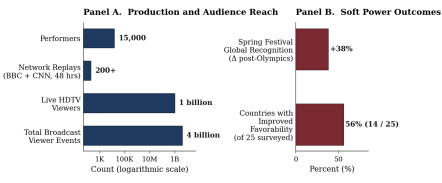
. Such mega-events provide context for this article, but their overall reception cannot be attributed specifically to lion dance. Evaluating the diplomatic effects of lion dance requires evidence that identifies the performance, the audience exposed to it, and the attitudes being measured.
Figure 1. Quantitative Indicators of the 2008 Beijing Olympics’ Cultural Reach and Soft Power Outcomes.
Note. Panel A reports production and audience-reach figures on a logarithmic scale; Panel B reports international-reception indicators as percentages. Data adapted from Nye (2008), Pew Research Center (2009), and BBC (2008).
Many of the thematic elements established in this ceremony were replicated for the 2010 Shanghai Expo and the 2022 Winter Olympics in Beijing. The performance received significant media coverage on a global scale and surpassed China’s original framing intent, thereby demonstrating the power of national narrative control but also the limitations of it in this new technologically enabled context.
There have also been many events that extend this narrative from the 2008 ceremony, including the 2026 Year of the Horse Spring Festival Gala at United Nations (UN) Headquarters with robotic lion dancing, the 2024 agreement between China and Malaysia to jointly nominate lion dance for the United Nations Educational, Scientific and Cultural Organization (UNESCO) Representative List of the Intangible Cultural Heritage of Humanity
[13]
Ip, C. (2024, August 25). China and Malaysia join forces to catapult lion dance onto Unesco cultural heritage list. South China Morning Post.
, and daily lion dance welcome ceremonies for the China International Import Expo (2018-2023) that drew attendees from over 200 countries.
5. Cases: Diaspora, Competition, and Digital-Driven
5.1. Rationale
The prior examples referred to above are focusing on two distinct areas: either there is a state (Chinese) or mega events happening within a state (Chinese) OR there are individuals (digital creators) creating digital content. The reason for this limited scope is due to the many intermediate/unified layers existing within these two poles of being which are the vast majority of the real-world/worldwide diplomatic weight associated with lion dance which lies in: diaspora-led festivals (mega diaspora marketed events), competitive circuits (carnival competitions), and the numerous ecosystems from corporations and artistic platforms which support both of the above.
Key examples are the San Francisco Chinese New Year Parade, which dates from the 1860s and is described by its organisers as the biggest Lunar New Year parade outside Asia
[14]
Chinese New Year Festival & Parade. (n.d.). History.
. Another example is the Sydney Chinese New Year Festival, produced by the City of Sydney since 1996, which attracted more than one million visitors in 2016
[16]
City of Sydney. (2016, March). Sydney’s biggest ever Chinese New Year [Media release].
. All of these events have foreign resources as hosts (city or diaspora) rather than the Chinese state as the host. Therefore, if overseas visibility/export is predominantly dependent on events created by outside authority of the Chinese state, then the ability of China to receive soft power credit through the creation of these events is not straightforward and may depend on the authenticity of the source of the community-led type of event produced.
5.2. Competitive / Commercial Circuits
The Genting World Lion Dance Championship (Malaysia), held biennially since 1994, is a leading international competition for high-pole lion dance. In 2018 it drew 36 teams from 16 countries, and a Malaysian team had won every edition as of 2021
[17]
Wang, M. (2021, February 9). Malaysia has turned lion dancing into a gravity-defying extreme sport. Atlas Obscura.
; its leading teams are therefore Malaysian rather than Chinese.
In Hong Kong, Southeast Asia, and other diasporas, the professional live performance for lion dance has adequate commercial opportunities, including grand openings, real estate handovers, and corporate anniversaries. In these areas, there are good supply of professional troupes and they are supported by a continual demand for performances.
5.3. Digital Circulation and Evidence Limits
Digital platforms provide channels through which lion dance performances can circulate beyond their immediate audiences. Research on Douyin, for example, shows how the platform has promoted intangible cultural heritage through professional creators, Multi-Channel Network agencies and algorithm-driven distribution, in collaboration with local governments
[18]
Paquienseguy, F., & Guo, Q. (2025). Douyin and the digital spread of intangible cultural heritage: Transforming cultural dissemination in the short videos age. Emerging Media, 3(2), 343-366.
. This circulation can connect official cultural programming, diaspora associations, and independent performers. However, platform visibility must be distinguished from cultural understanding and changes in attitudes toward China. This distinction is central to interpreting digital activity through a soft power framework
[3]
Nye, J. S. (2004). Soft power: The means to success in world politics. Public Affairs.
[19]
Nye, J. S., Jr. (2008). Public diplomacy and soft power. The ANNALS of the American Academy of Political and Social Science, 616(1), 94-109.
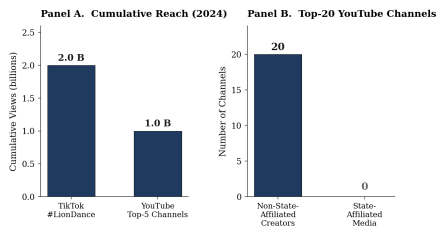
Figure 2. State versus Grassroots Footprint of Lion Dance Content on Major Digital Platforms (2024).
Note. Panel A shows cumulative views on TikTok (#LionDance) and the combined lifetime views of the top-five YouTube channels. Panel B shows the source-type composition of the top-twenty YouTube lion-dance channels: zero are state-run or state-affiliated. Data compiled from publicly reported platform statistics.
Comparisons of official and community-produced content require a clearly defined sample, a common observation period, and transparent classification of account ownership. View counts, subscriber totals, and engagement measures refer to different forms of activity and should not be treated as interchangeable indicators. Without these controls, neither a ranking of actor types nor a claim about audience preference can be established. A future comparative study could document these measures alongside qualitative analysis of audience responses.
5.4. Comparative Benchmarking
Lion dance has structural differences from Korean Hallyu (estimate billions in export revenue), Japanese anime (primarily driven by rights holder and converted to merchandise), Indian yoga (driven by grassroots with substantially de-nationalized identities), and Brazilian samba (primarily based in festivals with limited state-coordinated activity). Thus far, the economic footprint of lion dance is minimal due to the type of distribution of lion dance production, with substantial reliance on locally organized performances and diaspora networks. The regional commercial opportunities described above should be distinguished from a standardized global cultural industry. Based on these distinctions, lion dance is more like a distinct type of asset than an equivalent miniature version of Hallyu (e.g., less revenue, more authentically derived, more scattered in ownership, and less centralized control). Research on China’s cultural industries and soft power provides a wider context for these comparisons
[20]
Vlassis, A. (2016). Soft power, global governance of cultural industries and rising powers: The case of China. International Journal of Cultural Policy, 22(4), 481-496.
The preceding discussion identifies three circulation modes that should be compared without assuming a fixed hierarchy of diplomatic effectiveness. Official institutions may supply resources and a national framing; diaspora communities connect performance with local cultural life; and platform-based creators shape how performances are selected and shared. These modes overlap, and their audience effects require empirical assessment. Table 1 summarizes analytical distinctions rather than measured differences in reach, authenticity, or diplomatic outcomes
[10]
McGuire, C. P. (2024). Layered meanings of lion dance. In Martial sound: Drumming empowerment in diasporic Chinese kung fu and lion dance (pp. 77-116). Oxford University Press.
Table 1. Comparative Analysis of Lion Dance Circulation Modes.
Dimension
Official State Channels
Diaspora Communities
Platform-Based Creators
Organization
Institutional commissioning and coordination
Associations and local community networks
Creator decisions within platform rules
Authenticity to examine
How audiences interpret official sponsorship
How local practice and continuity are perceived
How performance and editing shape perceptions
Audience reach to measure
Event attendance and media distribution
Local participation and transnational networks
Views, engagement and repeat audiences
Attribution to examine
Whether attention translates into attitudes toward China
Whether appeal is associated with China, local identity or both
Whether viewers identify a national source
5.6. Official State Media: CCTV-4, CGTN, China Daily, Xinhua, China.com.cn
State media outlets, including China Central Television Channel 4 (CCTV-4), China Global Television Network (CGTN), China Daily, and Xinhua, form part of the institutional setting for international cultural communication
[7]
Zhu, Y. (2022). China’s “new cultural diplomacy” in international broadcasting: Branding the nation through CGTN Documentary. International Journal of Cultural Policy, 28(6), 671-683.
. The present discussion distinguishes the resources devoted to cultural projection from evidence of its reception. Assessing effectiveness requires clear definitions of audiences and outcomes, together with an account of how exposure to particular performances is measured
[12]
d’Hooghe, I. (2015). China’s public diplomacy. Brill.
Community organizations and independent creators also merit attention as participants in cultural circulation. Their relationship with official institutions may range from collaboration to independent production. The comparison should therefore examine funding, editorial decisions, performance settings, and audience interpretation rather than infer authenticity or influence from institutional affiliation alone
[10]
McGuire, C. P. (2024). Layered meanings of lion dance. In Martial sound: Drumming empowerment in diasporic Chinese kung fu and lion dance (pp. 77-116). Oxford University Press.
These overlapping channels suggest that the cultural visibility associated with a state can involve actors whose priorities are local, artistic, or commercial. Whether this visibility generates diplomatic benefits remains an empirical question.
6. Power Dynamics and Critical Analysis
6.1. Multi-Actor Field
The Chinese state functions primarily as a resource provider and legitimating authority within the broader lion dance ecosystem: it supplies funding, institutional infrastructure, and diplomatic framing to both official troupes and, indirectly, to community groups that benefit from state-backed cultural programming. However, the state does not monopolize production. Overseas Chinese communities assert grassroots legitimacy and, in several documented cases, have resisted co-option into official narratives. Generation Z creators are reconfiguring lion dance as a medium of personal expression and entertainment, generating organically circulated content that carries little of the state’s ideological framing. International media, in turn, tend to localize or depoliticize their coverage of performances. The net effect is a decentralized, multi-stakeholder field in which state agency is real but incomplete.
6.2. Propaganda vs Cultural Exchange
The two models differ in many ways: they differ in terms of intent (propaganda sharing/political/social engagement), they differ in terms of authenticity (process vs. intrinsic value), and they differ in terms of audiences (targets vs. equal partners). When lion dance performance is performed without political connections, branding, or official government framing, it is a cultural exchange. When lion dance is being used as part of a state branding strategy or messaging strategy to achieve specific diplomatic objectives, it is utilizing the state’s soft power propaganda tool. This distinction echoes wider debate on whether cultural diplomacy should be judged only by national interest or also by mutual exchange
[21]
Ang, I., Isar, Y. R., & Mar, P. (2015). Cultural diplomacy: Beyond the national interest? International Journal of Cultural Policy, 21(4), 365-381.
Several strands of evidence caution against equating cultural visibility with improved national standing. Shambaugh
[22]
Shambaugh, D. (2015). China’s soft-power push: The search for respect. Foreign Affairs, 94(4), 99-107.
[22]
argues that, despite substantial investment in media expansion and cultural programmes, China’s soft-power push has yielded limited returns because of constraints within its political system. Survey research points in a similar direction: Pew’s 2023 survey found a median of 67% of respondents in 24 countries holding unfavorable views of China
[11]
Silver, L., Huang, C., & Clancy, L. (2023, July 27). China’s approach to foreign policy gets largely negative reviews in 24-country survey. Pew Research Center.
, analysing opinion surveys from 2005 to 2018, report declining global sentiment towards China, particularly among wealthy democracies.
These findings do not concern lion dance directly, and they do not show that lion dance fails to improve attitudes. They do suggest three cautions for the argument of this article: cultural visibility should not be equated with cultural influence; positive responses to a cultural form may coexist with unfavorable views of the state; and heavy state involvement may affect how audiences receive cultural messages
[6]
Wang, C. Y. (2023). Changing strategies and mixed agendas: Contradiction and fragmentation within China’s external propaganda. Journal of Contemporary China, 32(142), 586-601.
Zhu, Y. (2022). China’s “new cultural diplomacy” in international broadcasting: Branding the nation through CGTN Documentary. International Journal of Cultural Policy, 28(6), 671-683.
Shambaugh, D. (2015). China’s soft-power push: The search for respect. Foreign Affairs, 94(4), 99-107.
[6, 7, 22]
.
7. Future Outlook and Conclusion
Through knowledge-sharing and working together, the state has the financial resources and legitimacy; the technology platforms provide distribution methods and creative tools; the traditional troupes provide the authenticity and artistic quality of performance; and, the overseas Chinese communities provide the local adaptation and audience trust and engagement.
This article proposes three possible initiatives: a Global Lion Dance Day coordinated by participating communities; a Digital Heritage Archive documenting regional performance styles; and an International Youth Training Camp connecting students with experienced practitioners. These are proposals for future collaboration, rather than descriptions of confirmed programs. Their feasibility would depend on community interest, resources, and governance arrangements that preserve artistic agency.
Lion dance offers a setting in which to examine the relationship between cultural performance and public diplomacy. Its visual and embodied form may enable engagement across linguistic boundaries, while its meanings remain dependent on context. The comparison developed here highlights official institutions, diaspora communities, and digital creators as distinct but overlapping participants. It does not establish a universal ranking of their diplomatic effectiveness. Following Nye’s account of attraction
[3]
Nye, J. S. (2004). Soft power: The means to success in world politics. Public Affairs.
[19]
Nye, J. S., Jr. (2008). Public diplomacy and soft power. The ANNALS of the American Academy of Political and Social Science, 616(1), 94-109.
, future evaluation should distinguish attention to a performance from sustained cultural understanding and attitudes toward China. Community participation and perceived authenticity remain relevant questions for investigation, rather than effects that can be assumed from sponsorship or platform reach alone.
Abbreviations
CBD
Central Business District
CCTV-4
China Central Television Channel 4
CGTN
China Global Television Network
PRC
People’s Republic of China
UN
United Nations
UNESCO
United Nations Educational, Scientific and Cultural Organization
Author Contributions
Xingxing Su: Conceptualization, Investigation, Resources, Writing – original draft, Writing – review & editing
Conflicts of Interest
The authors declare no conflicts of interest.
References
[1]
Lyu, S., Chan, R. S. K., & Olmedo, E. (2023). Sports and heritage: A review of the Chinese lion dance. Journal of Ethnic and Diversity Studies, 1(2), Article 4.
Xu, D., Phanlukthao, P., & Ke, Y. (2024). Cultural identity of Guangdong lion dance in Chinese intangible cultural heritage through anthropological perspectives. International Journal of Sociologies and Anthropologies Science Reviews, 4(4), 391-400.
Nye, J. S. (2004). Soft power: The means to success in world politics. Public Affairs.
[4]
Cummings, M. C. (2003). Cultural diplomacy and the United States government: A survey. Center for Arts and Culture.
[5]
Wang, Y. (2008). Public diplomacy and the rise of Chinese soft power. The ANNALS of the American Academy of Political and Social Science, 616(1), 257-273.
Wang, C. Y. (2023). Changing strategies and mixed agendas: Contradiction and fragmentation within China’s external propaganda. Journal of Contemporary China, 32(142), 586-601.
Zhu, Y. (2022). China’s “new cultural diplomacy” in international broadcasting: Branding the nation through CGTN Documentary. International Journal of Cultural Policy, 28(6), 671-683.
Yang, Y. (2024). Inheritance and promotion of traditional folk sports in the context of “One Belt and One Road”—Taking dragon and lion dance as an example. Advances in Physical Sciences, 12(2), 373-378.
McGuire, C. P. (2024). Layered meanings of lion dance. In Martial sound: Drumming empowerment in diasporic Chinese kung fu and lion dance (pp. 77-116). Oxford University Press.
Silver, L., Huang, C., & Clancy, L. (2023, July 27). China’s approach to foreign policy gets largely negative reviews in 24-country survey. Pew Research Center.
Paquienseguy, F., & Guo, Q. (2025). Douyin and the digital spread of intangible cultural heritage: Transforming cultural dissemination in the short videos age. Emerging Media, 3(2), 343-366.
Vlassis, A. (2016). Soft power, global governance of cultural industries and rising powers: The case of China. International Journal of Cultural Policy, 22(4), 481-496.
Su, X. (2026). Lion Dance as a Visual Symbol of Cultural and Public Diplomacy: A Theoretical and Case-Based Analysis of Soft Power, Digital Amplification, and Diasporic Agency. International Journal of Education, Culture and Society, 11(5), 255-261. https://doi.org/10.11648/j.ijecs.20261105.17
Su, X. Lion Dance as a Visual Symbol of Cultural and Public Diplomacy: A Theoretical and Case-Based Analysis of Soft Power, Digital Amplification, and Diasporic Agency. Int. J. Educ. Cult. Soc.2026, 11(5), 255-261. doi: 10.11648/j.ijecs.20261105.17
Su X. Lion Dance as a Visual Symbol of Cultural and Public Diplomacy: A Theoretical and Case-Based Analysis of Soft Power, Digital Amplification, and Diasporic Agency. Int J Educ Cult Soc. 2026;11(5):255-261. doi: 10.11648/j.ijecs.20261105.17
@article{10.11648/j.ijecs.20261105.17,
  author = {Xingxing Su},
  title = {Lion Dance as a Visual Symbol of Cultural and Public Diplomacy: A Theoretical and Case-Based Analysis of Soft Power, Digital Amplification, and Diasporic Agency},
  journal = {International Journal of Education, Culture and Society},
  volume = {11},
  number = {5},
  pages = {255-261},
  doi = {10.11648/j.ijecs.20261105.17},
  url = {https://doi.org/10.11648/j.ijecs.20261105.17},
  eprint = {https://article.sciencepublishinggroup.com/pdf/10.11648.j.ijecs.20261105.17},
  abstract = {This article examines how Chinese lion dance functions as a visual symbol in cultural and public diplomacy and argues that its soft power potential depends on the conditions of its circulation. Drawing on theories of soft power and cultural diplomacy and on research on China’s external propaganda, the discussion compares three overlapping settings: state-sponsored performances, diaspora-led festivals and competitions, and platform-based cultural content. It considers how institutional sponsorship, community ownership, and digital distribution may shape perceptions of authenticity and the attribution of cultural appeal to China. The analysis distinguishes the visibility of a performance from evidence of improved national reputation or sustained diplomatic influence. It also treats audience size, platform engagement, and reported cultural interest as different indicators whose implications cannot be assumed to be equivalent. The cases suggest that diaspora organizations and independent performers warrant greater attention alongside official cultural programming. However, differences in reach do not by themselves demonstrate that audiences prefer one sponsor type or that state involvement necessarily reduces attraction. The article therefore presents community agency and perceived authenticity as important interpretive considerations rather than universally established causal effects. It concludes that lion dance may support cross-cultural engagement when performances are locally meaningful and accompanied by opportunities for exchange. Assessing its diplomatic contribution requires transparent evidence, attention to audience interpretation, and recognition that cultural appreciation may remain distinct from attitudes toward the state.},
 year = {2026}
}
TY  - JOUR
T1  - Lion Dance as a Visual Symbol of Cultural and Public Diplomacy: A Theoretical and Case-Based Analysis of Soft Power, Digital Amplification, and Diasporic Agency
AU  - Xingxing Su
Y1  - 2026/10/09
PY  - 2026
N1  - https://doi.org/10.11648/j.ijecs.20261105.17
DO  - 10.11648/j.ijecs.20261105.17
T2  - International Journal of Education, Culture and Society
JF  - International Journal of Education, Culture and Society
JO  - International Journal of Education, Culture and Society
SP  - 255
EP  - 261
PB  - Science Publishing Group
SN  - 2575-3363
UR  - https://doi.org/10.11648/j.ijecs.20261105.17
AB  - This article examines how Chinese lion dance functions as a visual symbol in cultural and public diplomacy and argues that its soft power potential depends on the conditions of its circulation. Drawing on theories of soft power and cultural diplomacy and on research on China’s external propaganda, the discussion compares three overlapping settings: state-sponsored performances, diaspora-led festivals and competitions, and platform-based cultural content. It considers how institutional sponsorship, community ownership, and digital distribution may shape perceptions of authenticity and the attribution of cultural appeal to China. The analysis distinguishes the visibility of a performance from evidence of improved national reputation or sustained diplomatic influence. It also treats audience size, platform engagement, and reported cultural interest as different indicators whose implications cannot be assumed to be equivalent. The cases suggest that diaspora organizations and independent performers warrant greater attention alongside official cultural programming. However, differences in reach do not by themselves demonstrate that audiences prefer one sponsor type or that state involvement necessarily reduces attraction. The article therefore presents community agency and perceived authenticity as important interpretive considerations rather than universally established causal effects. It concludes that lion dance may support cross-cultural engagement when performances are locally meaningful and accompanied by opportunities for exchange. Assessing its diplomatic contribution requires transparent evidence, attention to audience interpretation, and recognition that cultural appreciation may remain distinct from attitudes toward the state.
VL  - 11
IS  - 5
ER  -
Su, X. (2026). Lion Dance as a Visual Symbol of Cultural and Public Diplomacy: A Theoretical and Case-Based Analysis of Soft Power, Digital Amplification, and Diasporic Agency. International Journal of Education, Culture and Society, 11(5), 255-261. https://doi.org/10.11648/j.ijecs.20261105.17
Su, X. Lion Dance as a Visual Symbol of Cultural and Public Diplomacy: A Theoretical and Case-Based Analysis of Soft Power, Digital Amplification, and Diasporic Agency. Int. J. Educ. Cult. Soc.2026, 11(5), 255-261. doi: 10.11648/j.ijecs.20261105.17
Su X. Lion Dance as a Visual Symbol of Cultural and Public Diplomacy: A Theoretical and Case-Based Analysis of Soft Power, Digital Amplification, and Diasporic Agency. Int J Educ Cult Soc. 2026;11(5):255-261. doi: 10.11648/j.ijecs.20261105.17
@article{10.11648/j.ijecs.20261105.17,
  author = {Xingxing Su},
  title = {Lion Dance as a Visual Symbol of Cultural and Public Diplomacy: A Theoretical and Case-Based Analysis of Soft Power, Digital Amplification, and Diasporic Agency},
  journal = {International Journal of Education, Culture and Society},
  volume = {11},
  number = {5},
  pages = {255-261},
  doi = {10.11648/j.ijecs.20261105.17},
  url = {https://doi.org/10.11648/j.ijecs.20261105.17},
  eprint = {https://article.sciencepublishinggroup.com/pdf/10.11648.j.ijecs.20261105.17},
  abstract = {This article examines how Chinese lion dance functions as a visual symbol in cultural and public diplomacy and argues that its soft power potential depends on the conditions of its circulation. Drawing on theories of soft power and cultural diplomacy and on research on China’s external propaganda, the discussion compares three overlapping settings: state-sponsored performances, diaspora-led festivals and competitions, and platform-based cultural content. It considers how institutional sponsorship, community ownership, and digital distribution may shape perceptions of authenticity and the attribution of cultural appeal to China. The analysis distinguishes the visibility of a performance from evidence of improved national reputation or sustained diplomatic influence. It also treats audience size, platform engagement, and reported cultural interest as different indicators whose implications cannot be assumed to be equivalent. The cases suggest that diaspora organizations and independent performers warrant greater attention alongside official cultural programming. However, differences in reach do not by themselves demonstrate that audiences prefer one sponsor type or that state involvement necessarily reduces attraction. The article therefore presents community agency and perceived authenticity as important interpretive considerations rather than universally established causal effects. It concludes that lion dance may support cross-cultural engagement when performances are locally meaningful and accompanied by opportunities for exchange. Assessing its diplomatic contribution requires transparent evidence, attention to audience interpretation, and recognition that cultural appreciation may remain distinct from attitudes toward the state.},
 year = {2026}
}
TY  - JOUR
T1  - Lion Dance as a Visual Symbol of Cultural and Public Diplomacy: A Theoretical and Case-Based Analysis of Soft Power, Digital Amplification, and Diasporic Agency
AU  - Xingxing Su
Y1  - 2026/10/09
PY  - 2026
N1  - https://doi.org/10.11648/j.ijecs.20261105.17
DO  - 10.11648/j.ijecs.20261105.17
T2  - International Journal of Education, Culture and Society
JF  - International Journal of Education, Culture and Society
JO  - International Journal of Education, Culture and Society
SP  - 255
EP  - 261
PB  - Science Publishing Group
SN  - 2575-3363
UR  - https://doi.org/10.11648/j.ijecs.20261105.17
AB  - This article examines how Chinese lion dance functions as a visual symbol in cultural and public diplomacy and argues that its soft power potential depends on the conditions of its circulation. Drawing on theories of soft power and cultural diplomacy and on research on China’s external propaganda, the discussion compares three overlapping settings: state-sponsored performances, diaspora-led festivals and competitions, and platform-based cultural content. It considers how institutional sponsorship, community ownership, and digital distribution may shape perceptions of authenticity and the attribution of cultural appeal to China. The analysis distinguishes the visibility of a performance from evidence of improved national reputation or sustained diplomatic influence. It also treats audience size, platform engagement, and reported cultural interest as different indicators whose implications cannot be assumed to be equivalent. The cases suggest that diaspora organizations and independent performers warrant greater attention alongside official cultural programming. However, differences in reach do not by themselves demonstrate that audiences prefer one sponsor type or that state involvement necessarily reduces attraction. The article therefore presents community agency and perceived authenticity as important interpretive considerations rather than universally established causal effects. It concludes that lion dance may support cross-cultural engagement when performances are locally meaningful and accompanied by opportunities for exchange. Assessing its diplomatic contribution requires transparent evidence, attention to audience interpretation, and recognition that cultural appreciation may remain distinct from attitudes toward the state.
VL  - 11
IS  - 5
ER  -




 Share This Article
 Twitter
 Linked In
 Facebook
 Copy
Copy Download